

San Diego Dual Diagnosis Treatment Center
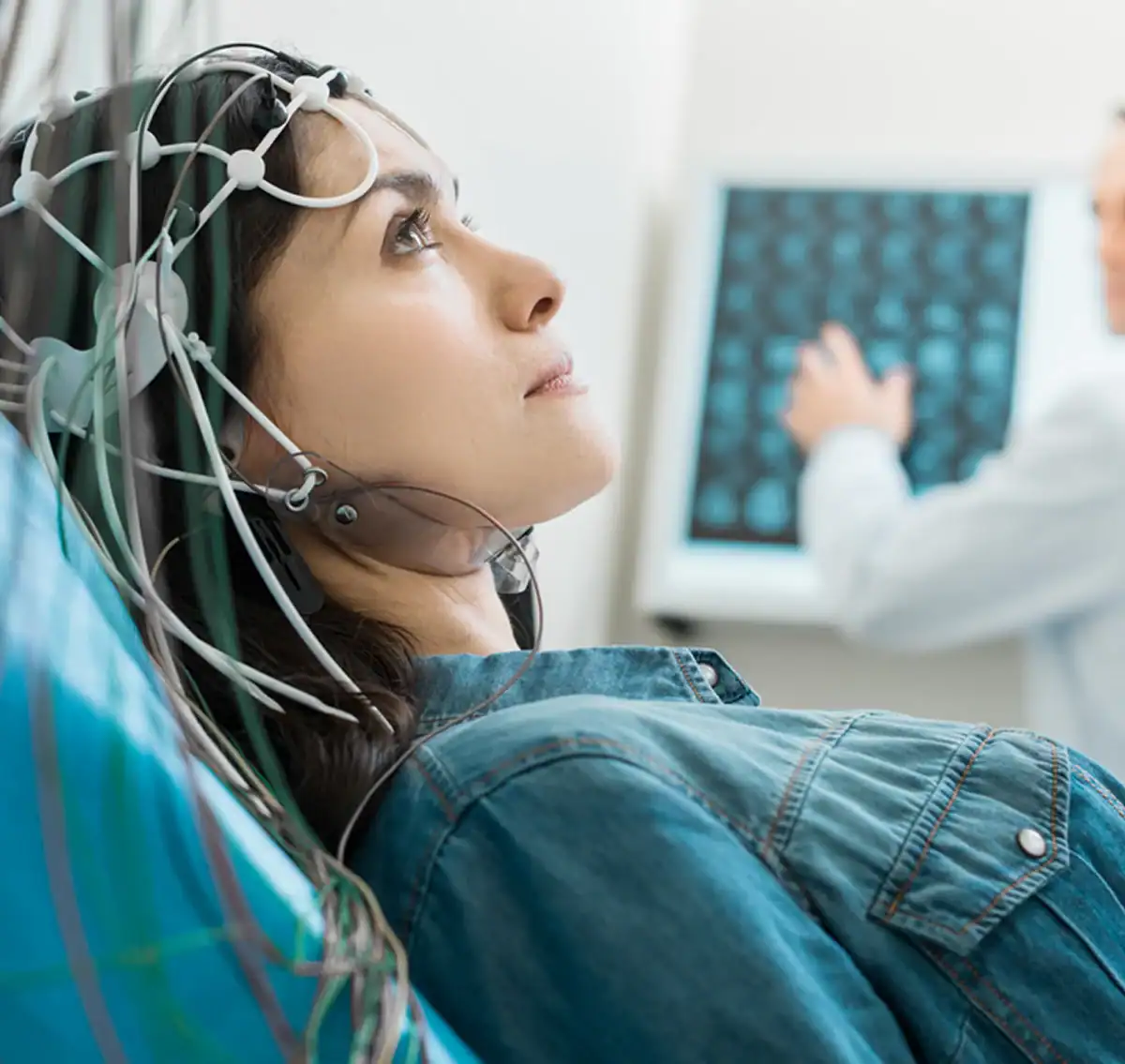
qEEG brain mapping is a non-invasive assessment that records your brain's electrical activity and turns it into a visual map of how different regions are working. At Healthy Life Recovery in San Diego, we use quantitative electroencephalography (qEEG) as one input into treatment planning for adults in our outpatient addiction and mental health programs. Recording and interpretation take about 30 minutes, the sensors sit on the scalp, and nothing enters the body.
Brain mapping does not diagnose a condition on its own, and it does not replace an evaluation by a clinician. What it adds is objective information about brainwave patterns that our medical and clinical team can weigh alongside your history, symptoms, and goals when we build your plan. For many of the people we see, that plan involves dual diagnosis treatment, where understanding what is happening underneath the substance use is the whole point.

qEEG stands for quantitative electroencephalography. It measures the electrical activity your brain is already producing and renders it as a map, which is why most people call it brain mapping.
Your neurons communicate in rhythmic pulses. Those pulses group into frequency bands, and the balance between them shifts depending on what your brain is doing and how it is doing it. A map shows where activity across those bands runs elevated, reduced, or typical compared with what would be expected. Clinicians use that picture as a reference point when thinking through attention, mood regulation, sleep, and stress response.
We record using a CGX dry-electrode EEG system, which uses sensors that make contact without conductive gel. Dry electrodes are what keep the session quick and let you leave without needing to wash your hair.
Brain mapping earns its place when it changes a conversation your care team was already having. Here is where it actually helps.
We offer qEEG brain mapping to adults enrolled in or entering care at Healthy Life Recovery, as part of a broader assessment. The conditions below are areas where brainwave patterns have been studied in the research literature. They are not conditions that qEEG diagnoses on its own, and a brain map is never the basis for a diagnosis here.
Brainwave patterns in ADHD have been studied for decades, particularly in regions tied to attention and impulse control.
A map can add context to the picture your clinician builds from history, rating scales, and interview. It does not settle the question of whether someone has ADHD.
Mapping can show where activity is elevated or reduced across the cortex, which may add context to what someone describes about their anxiety.
For people whose anxiety and substance use feed each other, the real work happens in treatment that addresses both at once, with mapping as one supporting input.
Researchers have described brainwave patterns associated with depression, and it is one of the more active areas of qEEG study.
In practice, we use mapping to add texture to the assessment behind our depression care, not to grade severity or sort depression into types.
Electrical activity differs across mood states, and a map captures a snapshot of where someone is at the time of recording.
Because bipolar disorder is defined by change over time, a single map has real limits here. It supports the longer clinical picture we build with you.
Studies have examined brainwave patterns in trauma survivors, including patterns associated with hyperarousal.
Mapping does not explain why a specific person has flashbacks, and it does not identify a cause. Where trauma and substance use overlap, our work centers on trauma-focused therapy.
Neural patterns associated with obsessive and compulsive symptoms have been examined in the qEEG literature.
For our team, that information sits alongside clinical assessment when planning therapy and, where appropriate, TMS, which is FDA-cleared for OCD and major depressive disorder.
Sustained substance use affects the same networks that qEEG measures, so mapping can offer a view of brain function at a point in recovery.
We use it to inform how we structure care, not to predict whether someone will stay sober. No test does that.
Research into qEEG reaches well past the conditions we treat. What we can speak to is how we use it here, which is as one assessment among several for adults in our addiction and mental health programs.
The brain runs on connected hubs that link memory, decision-making, and emotional processing. Sustained exposure to alcohol and other drugs puts pressure on those connections, and people usually notice it as trouble with attention, memory, anxiety, or low mood. Most substances also drive abnormal dopamine release. Dopamine is central to the brain's reward system, and repeated disruption of that system is part of what makes stopping so hard.
Some of this recovers. Function often improves with sustained abstinence and treatment, though how much and how fast varies a great deal from person to person.
Addiction pulls on genetics, environment, and behavior at the same time, and no single gene explains it. Sustained substance use is associated with lasting changes in how genes are regulated, which is a different thing from changing your genetic code. Those regulatory changes affect how brain cells communicate, and they are part of why substance use disorder reshapes reward and decision-making.
Our position is straightforward. Addiction is a treatable medical condition and it deserves the same precision we would bring to any other. Brain mapping is one of the tools we use to bring that precision to treatment planning, reviewed by our medical and clinical team alongside everything else we know about you.
qEEG is non-invasive and painless. The sensors read signals your brain is already producing. Nothing is sent into the brain, nothing enters the body, and there is no radiation involved.
Research on qEEG is active and genuinely uneven, and you deserve both halves of that.
Studies have described brainwave patterns associated with depression and with ADHD, and published reviews of quantitative electroencephalography describe its use in research and specialist clinical settings. Those findings are real, and they are why the tool is worth having.
At the same time, qEEG is not accepted as a stand-alone diagnostic test for psychiatric conditions, and several commercial health plans classify it as investigational for mental health diagnosis. Any provider who tells you a brain map can diagnose your depression, your ADHD, or your addiction is telling you something the evidence does not support.
We treat brain mapping as supplementary information rather than an answer. It informs the plan. It never replaces the clinical evaluation, and it never stands in for a conversation with your psychiatrist or therapist.
A brain map on its own is a picture. What makes it useful is what sits around it.
Healthy Life Recovery runs a full outpatient continuum in Pacific Beach, from medically supervised detox through PHP, IOP, and Evening IOP for people who cannot pause work or school. qEEG sits inside that continuum as an assessment input, not as a standalone service you book and leave.
It also sits alongside the other precision tools our psychiatric team uses. GeneSight looks at how your body metabolizes psychiatric medications. TMS is a treatment, FDA-cleared for major depressive disorder and OCD. qEEG is neither of those. It is a measurement, and its value is in helping the team decide where to look next.
Yes. The sensors only read electrical activity your brain is already producing. Nothing is sent into the brain, nothing enters the body, and there is no radiation. Most people find the session boring, which is the point.
No. A brain map is one piece of information your care team reviews alongside your history, your symptoms, and clinical assessment. Diagnosis is made by a clinician, not by a test.
About 30 minutes from the start of recording through interpretation. You can drive yourself home afterward and go straight back to your day.
Coverage varies a great deal by plan, and some carriers do not cover qEEG for mental health indications at all. Our admissions team verifies your benefits at no cost before anything is scheduled, so you know where you stand first.
MRI and CT show structure, meaning what the brain looks like. qEEG shows function, meaning the electrical activity happening moment to moment. They answer different questions, and qEEG is not a replacement for imaging your doctor has ordered.
Brain mapping is one part of how we build a plan, and the plan starts with a conversation. Our admissions team can tell you whether qEEG makes sense for your situation, walk you through the level of care that fits, and verify your benefits at no cost before anything is scheduled.
Posted on Google Debra OliversenTrustindex verifies that the original source of the review is Google. I am a recent client just retuning home from Healthy Life Recovery in San Diego, California. My intention was to stay only 30 days, however, I stayed almost one year. The staff is extremely knowledgeable and kept me engaged. I stayed at two sober living homes throughout my stay and they were both very clean and nice. The treatment and therapy I received was also quite helpful. I am sober today because Healthy Life allowed me to grow. I have found a new passion for life and will Forever, be grateful.Posted on Google Jill StrengerTrustindex verifies that the original source of the review is Google. I’m very grateful to Healthy Life Recovery for the amazing help given to me on my sobriety journey. I’ve spent years fighting childhood trauma and with the help of my wonderful therapist, Rachel I’ve been able to move past it. I can’t thank enough the owners Ryan & Keith, the Clinical Director Dr. Bonnie or the outstanding staff. The HLR staff are a wonderful bunch of kind people who really care about others success at long term sobriety. They were fortunate enough to survive this disease and they want you or your loved one to survive too. If you are looking to get sober and Stay Sober Healthy Life will get you and Keep You There!Posted on Google Mark BuccolaTrustindex verifies that the original source of the review is Google. I had been struggling with some major mental issues since August of 2024, which is when I admitted myself into a mental health facility for six nights and seven days in the San Fernando Valley. I wasn't able to get the proper after care treatment in Los Angeles due to Red Tape and lack of facilities. I reached out to Mädchen Amic who is the Founder/President of the Don't Mind Me Foundation in Palm Springs, Ca.I worked with her on Twin Peaks , Then Twin Peaks:The Return, and knew about her Foundation, and let her know my current situation. She was aware my past struggles. She contacted Keith Blanenship, who is the Executive Director at Healthy Life Recovery in San Diego,Ca.Within minutes, Keith contacted me. After a few minutes on then phone, He invited me down to check out their programs and facilities. The next day I drove down and was greeted by Keith. He gave me a guided tour of their operations. I was then introduced to Bonnie Mitchell, who is the Clinical Director at Healthy Life Recovery.Within seconds, I knew I had found the right home to get the help needed.What I didn't realize is that Mädchen had arranged a sponsorship thru The Don't Mind Me Scholarship Fund. I checked in two days later and had my Intake meeting with Bonnie. When that ended, I was then sent to my house I would be living at for a undecided amount of time. I want to thank Jody (House Captain) and my other six roommates who made me feel welcome and relaxed during my stay. My day consisted of four classes, medical checkups and weekly one on ones with Bonnie. Weekend events such as giving back to the community (Trash Clean Ups, Graffiti Removal), Hiking, Kickball, Volleyball, Softball, Canoeing are just some of the weekend events provided. After three weeks I felt I was ready to get back home, which was a tough decision because I enjoyed every second of my experience at Healthy Life Recovery. I am am now on their Out Patient program which includes daily assignments, Telehealth appointments and in person appointments with them once a month.I enjoy having the opportunity to still be involved with Healthy Life Recovery. I am now part of their Alumni Group, which means I can share my story with people with the same issues I have, and to inspire them the way I have been. I want to thank all of the staff and fellow clients at Healthy Life recovery. for helping me getting my life back on track.Posted on Google Chad YoungTrustindex verifies that the original source of the review is Google. I definitely wanted to add a positive review from my time at Healthy Life. Recently finished my program and I am cannot say enough good things about their program or “community” of staff / clients / owners. Like many, I have been in many rehabs and sober living houses and almost always felt like a number or just money for the programs. I came out to California for rehab and everyone there served as a secure replacement for family at home. To my surprise, I found nearly everything from their groups, community outings, individual therapy, and options for exercise / MMA training the perfect combination for myself. Added, I have sat through endless rehab groups over the years and basically watched the clock for them to end. Healthy Life’s groups and therapy actually sunk into my stubborn head. The therapists / case managers / group facilitators are very knowledgeable and organized with goals to better you emotionally and physically. Anyways, I will always be grateful for my time in their program, something I cannot say for most of my rehab experiences.Posted on Google Seif AbutayehTrustindex verifies that the original source of the review is Google. Healthy life saved my life and I am so grateful to them. The staff were super understanding and compassionate. I was able to process and accept a lot of my life through individual therapy as well as group therapy with my peers.Posted on Google Tristen SnowTrustindex verifies that the original source of the review is Google. Healthy Life Recovery is place to recover, change your life, and make connections with people trying to do the same thing. There are sober housing options as well. Basically Healthy Life is a key into a fantastic recovery community, as well as the knowledge you walk away with. They really teach you "how to fish sober" at this place. Big shout out to all the staff as well everyone I met really fostered growth. THANK YOU HEALTHY LIFE.Posted on Google Kirill MiroshkhinTrustindex verifies that the original source of the review is Google. I’ve been deeply grateful for the benefits I received from their program. The group sessions bring together individuals from very diverse backgrounds, often creating powerful spaces for vulnerability, insight, and moments of real healing. That said, true recovery begins when you make a wholehearted commitment to yourself and take full accountability for your journey. After all, you’re the only one who is with yourself 24/7. During the group sessions, be honest and open. Listen not only to the facilitators, but also to your fellow peers—everyone has something valuable to offer, especially when the group is engaged and present. Healing is possible—and it begins with you. Good luck!Posted on Google Allison SmithTrustindex verifies that the original source of the review is Google. I went to HLR for a year and it is hands down the best program in SD. The staff go above and beyond for the clients and truly care about their well being. I would recommend HLR to anyone looking to get better.
Dr. John Allen, MD is a psychiatrist in El Cajon, CA and has over 45 years of experience in the medical field. Dr. Allen has extensive experience in Addiction & Substance Abuse and Psychotic Disorders. He graduated from Baylor University in 1976.